Beyond Next-Token Prediction: Why Agentic AI Needs Causal Guardrails

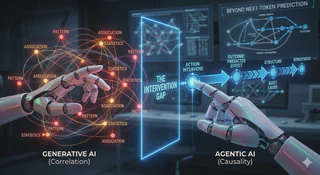 Image credit: Unsplash
The AI industry is currently undergoing a massive shift: we are moving from Generative AI (models that talk) to Agentic AI (models that act). We are empowering LLMs to browse the web, execute code, and manage complex workflows. However, as we grant AI more “agency,” we are hitting a fundamental wall. Most current agents are brilliant at pattern matching but completely blind to causation.
The Intervention Gap
Current agents operate primarily on the first rung of Judea Pearl’s “Ladder of Causation”: Association. They see that “A” often follows “B” and assume they are related. But an agent doesn’t just observe; it intervenes.
When an agent takes an action, it changes the system. To do this reliably, it must understand the difference between a spurious correlation and a true causal link. Without this, agents fall into “hallucination loops”—repeating failed actions because they don’t understand the underlying mechanism of why the failure occurred.
Solving the “Messy Data” Problem
Most real-world data, especially in high-stakes fields like healthcare and climate science, is “messy.” In my research, I’ve focused on building frameworks like CDANs and DCD (Decomposition-based Causal Discovery) that can handle temporal causal discovery even when data is shifting over time.
By applying these methods to challenges like Arctic Sea Ice Prediction, we’ve shown that causal models achieve significantly higher robustness under distribution shifts compared to purely correlation-based deep learning.
The Path to Robust Autonomy
The future of Agentic AI isn’t just “more parameters.” It is the integration of Structural Causal Models (SCMs) with the reasoning flexibility of LLMs. We need agents that don’t just ask “What comes next?” but “If I change this, what will happen—and why?”
